Most growing businesses in India have the same quiet problem. Enquiries arrive from everywhere - phone calls, WhatsApp, IndiaMART, JustDial, Instagram, the website, walk-ins - and each salesperson tracks them in their own way. Some leads get a quick reply. Others get forgotten. Nobody knows exactly how many.
A CRM (customer relationship management) system fixes this by putting every lead, conversation and follow-up in one place. This guide explains when you need one, what it should do, and what it costs in India.
Signs your business is leaking leads
You probably need a CRM if:
- Leads arrive from more than two channels and are tracked on paper, Excel or in personal phones.
- Follow-ups depend on memory. A prospect says "call me next week" - and next week nobody calls.
- You cannot answer simple questions like "Which lead source brought us the most paying customers last month?"
- When a salesperson leaves, their contacts and conversations leave with them.
- You suspect slow replies are costing deals, but you cannot measure response time.
Each of these is a revenue problem disguised as an admin problem.
What a CRM actually does
A good CRM for a small or medium business does five things well:
- Captures leads automatically from your website forms, IndiaMART, Facebook and Instagram lead ads, Google Ads and calls - so nobody has to type them in.
- Assigns every lead an owner and a next action, with reminders.
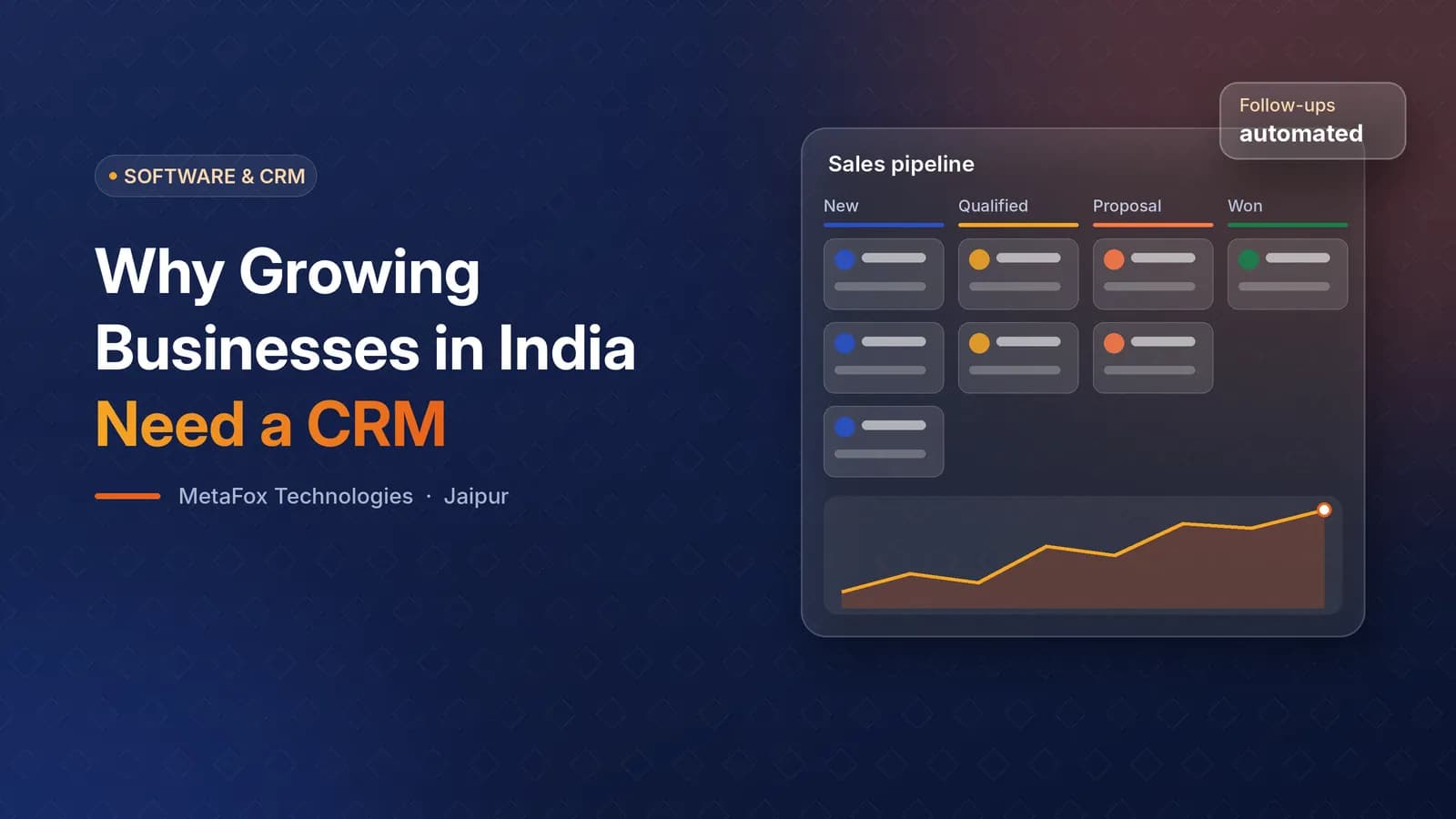
- Shows a sales pipeline - new, contacted, qualified, proposal sent, negotiation, won or lost - so you can see where deals are stuck.
- Stores the full history of calls, messages, quotations and notes for each customer.
- Reports what matters - leads by source, conversion rate by salesperson, response time and expected revenue.
Many CRMs also send WhatsApp or email templates, create quotations and remind you about renewals or repeat orders.
The maths: why a CRM pays for itself
Imagine your business receives 50 leads a month and converts 10% - five new customers. If your average sale is ₹30,000, that is ₹1.5 lakh in monthly revenue.
Now suppose consistent follow-up lifts conversion from 10% to 12%. That is one extra customer every month - ₹30,000 more revenue each month, or ₹3.6 lakh a year. A CRM setup in the ₹25,000–₹45,000 range pays for itself in the first month or two, before counting the hours saved on manual tracking.
Ready-made CRM or custom CRM?
Ready-made CRM (Zoho, HubSpot, etc.)
- Time to start: 1–2 weeks
- Upfront cost: low (setup only)
- Ongoing cost: per-user monthly licence
- Fit: standard sales processes
- Ownership: the vendor's platform
Custom-built CRM
- Time to start: 4–8 weeks
- Upfront cost: higher (development)
- Ongoing cost: hosting only - no per-user fee
- Fit: your exact workflow and fields
- Ownership: you own the code and data
Choose ready-made if you have a small team, a fairly standard sales process and want to start this month.
Choose custom if your process is unique (for example, real estate site visits, dealer orders, admission counselling), your team is growing and per-user fees are adding up, or you need deep integration with your billing or ERP.
What does a CRM cost in India?
- CRM setup and integration (configuring a CRM, connecting lead sources, pipeline, templates, training): typically ₹25,000–₹45,000 one-time, plus the CRM's own licence if you use a ready-made product.
- Custom CRM development: typically ₹80,000–₹2,50,000 depending on modules, user roles and integrations - with no per-user monthly fees afterwards.
See the full breakdown on our CRM development page.
How to make sure your team actually uses it
The biggest risk with any CRM is that the team ignores it. To avoid that:
- Start simple - only the fields and stages your team really needs.
- Automate data entry - leads should arrive in the CRM by themselves.
- Make it mobile - salespeople live on their phones.
- Train everyone and review the pipeline together weekly.
- Lead from the top - if the owner asks "what does the CRM say?", the team updates it.
The bottom line
If your business is growing and leads come from several channels, a CRM is one of the fastest-paying investments you can make. Start small, automate lead capture, and measure follow-up.
Not sure whether you need a ready-made or custom CRM? Book a free consultation - we will look at your lead sources and sales process and recommend the simplest option that works.